
How posting frequency affects growth on Instagram
Source: Buffer
This probably won’t surprise any veteran Instagram creators: The more you post, the more likely you are to reach new people and grow your audience.
Buffer’s resident data scientist Julian Winternheimer sliced and diced the data several different ways, and no matter which angle you take, a higher posting frequency means more reach and growth.
There’s some nuance here, of course — we’ll dig into that below, too.
Before we get into it: In this analysis, we looked at Instagram feed posts — so photos, reels, and carousels — not Instagram Stories.
Since stories are not typically shown to non-followers, they’re wonderful for engaging current fans, but not a game-changer for growing your account.
With that in mind, Julian analyzed the performance and posting frequency of 2.1 million posts from 102K Instagram accounts. He classed posting frequency into five different ‘buckets ’:
No posts
1-2 posts per week
3-5 posts per week
6-9 posts per week
10+ posts
In this study, he didn’t segment reels, single-photo posts, and carousels. All three of these formats are included.
Here’s what he uncovered.
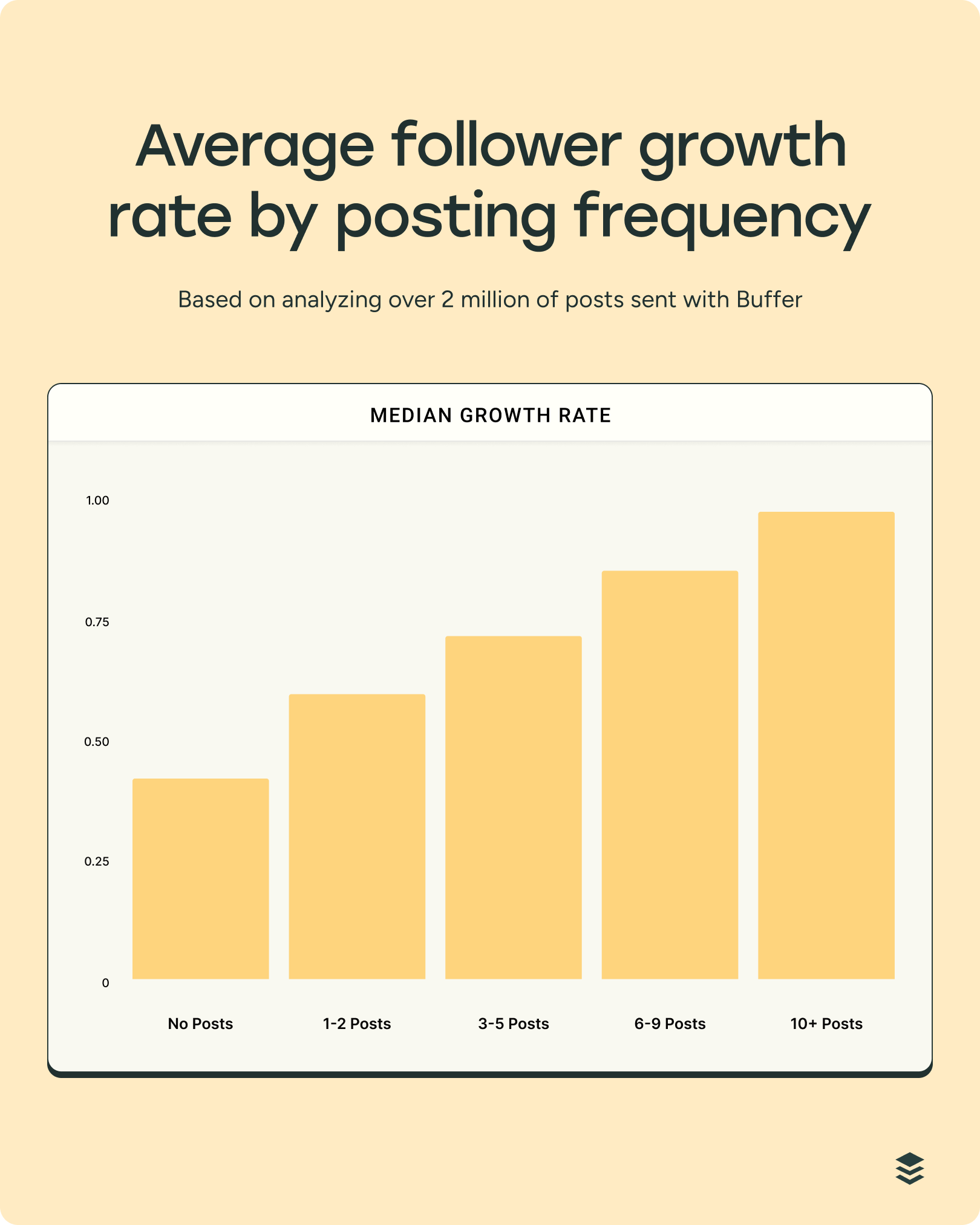
1. More posts per week means more growth
First, he explored the link between posting frequency and growth, which, as Julian puts it, “shows a strong positive correlation.”
As cool as this is to see, take this analysis with a pinch of salt. “This relationship is nice to see, but it may not tell us the full story,” Julian says. “We need to control for differences in accounts’ natural growth rates.”
The simple (can we call it simple..?) calculation doesn’t account for the differences in the natural growth of large accounts versus small ones. Larger accounts that grow faster might naturally post more.
“For example, imagine a fast-growing account that gains 1,000 followers per week and posts 20 times, while a smaller account gains 10 followers per week and only posts twice,” Julian explains.
“If we simply average these together, we might conclude that posting 20 times leads to fast growth. However, the larger account would likely gain a higher number of followers even if they posted less frequently.”
So, without accounting for these differences in accounts, we can’t tell whether frequent posting causes growth, or whether naturally fast-growing accounts just happen to post more.
To confirm the correlation between posting frequency and growth, Julian did the slicing and dicing I mentioned.
Instead of comparing different accounts, this method (called a z-score analysis) compares each account to its own baseline level of growth. So, essentially, comparing each account to itself.
For each account, he calculated their average follower growth rate across all weeks, and how much that number tends to vary (i.e., their standard deviation).
Then he looked at how each individual week compared to that average.
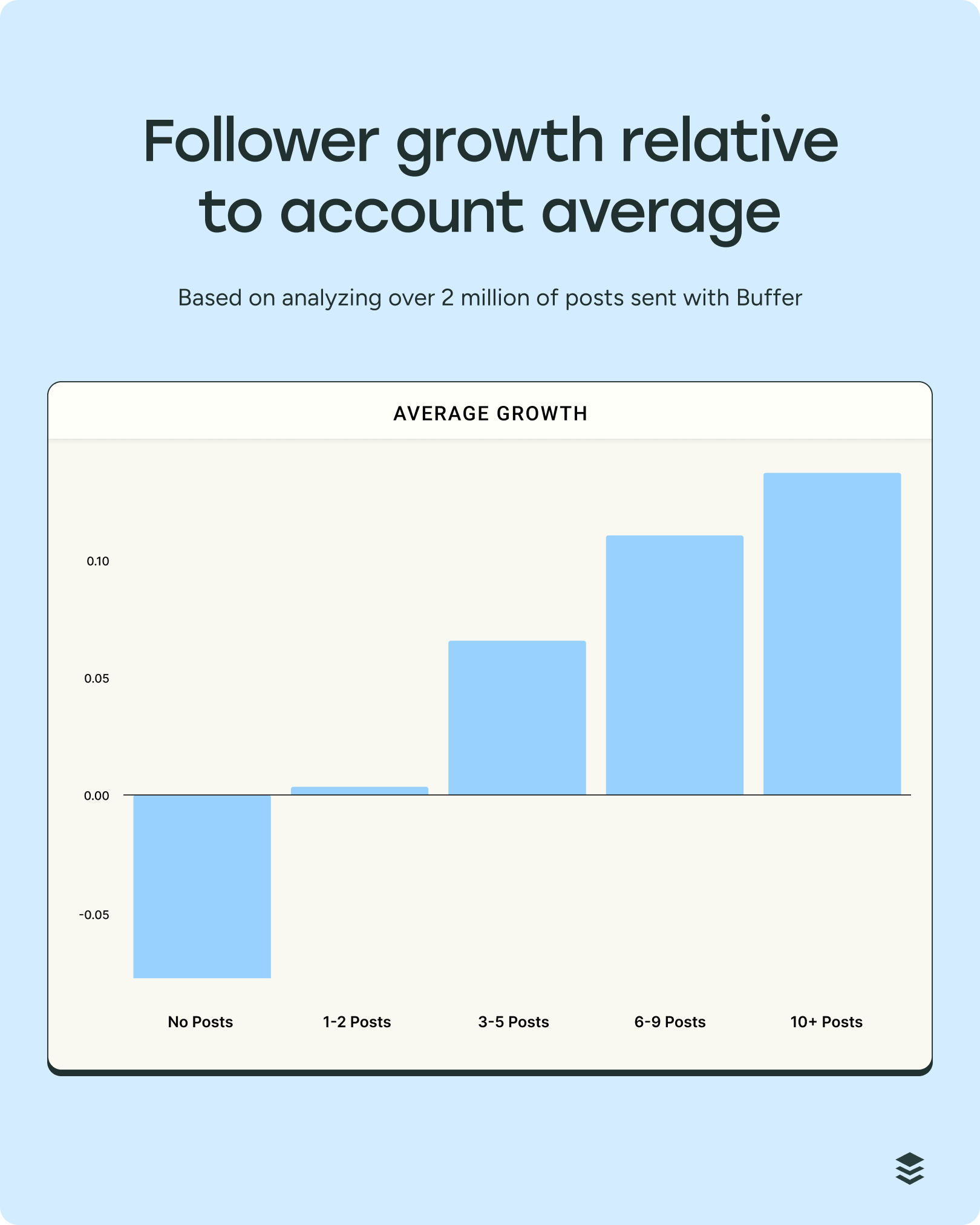
Here’s the data presented another way:
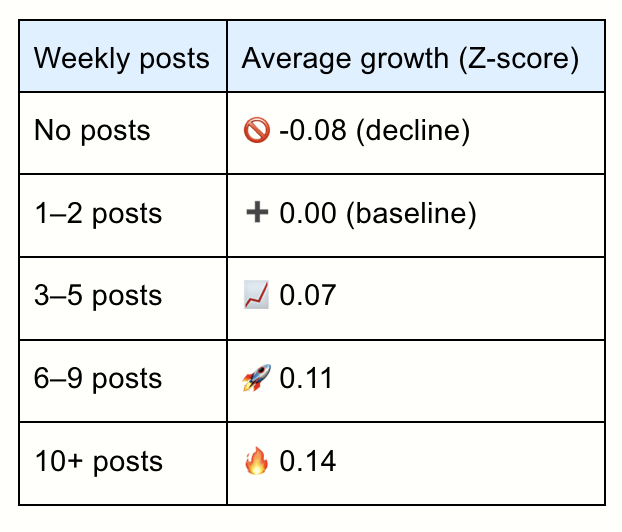
And how he defined these Z-scores:
Z = 0: Typical performance for this channel
Z = +1: Strong positive week (better than ~84% of weeks)
Z = +2: Exceptional week (better than ~97% of weeks)
Z = -1: Poor week (worse than ~84% of weeks)
“This data suggests that there is a strong positive relationship between posting frequency and follower growth on Instagram,” Julian says. “Channels that post more frequently consistently gain more Instagram followers relative to their baseline.”
2. Not posting at all could mean a loss of followers
You may have already spotted this — but take a look at the ‘No posts’ bar again. The analysis above also shows there is a cost to not posting.
Julian has dubbed this the “no-post penalty”.
On average, weeks with zero posts had follower growth that was ~0.08 standard deviations below the account’s typical growth.
In plain English, that might mean account stagnation, or even follower loss. As an Instagram creator, I can personally attest to the fact that no-content weeks — especially consecutive ones — could result in a slow, steady decline in followers.
“Channels that don’t post at all significantly under-perform their baseline growth rates,” Julian says. “Even posting once or twice a week results in a significant increase in follower growth compared to weeks with no posts.”
3. Consistent posting drives real, measurable growth
In another analysis, Julian explored how much posting frequency can impact growth, compared to weeks when users don’t post at all.
Like the Z-score model, the fixed-effects model also compares each account to itself, but instead of examining individual weeks, it focuses on isolating the effect of posting more or less.
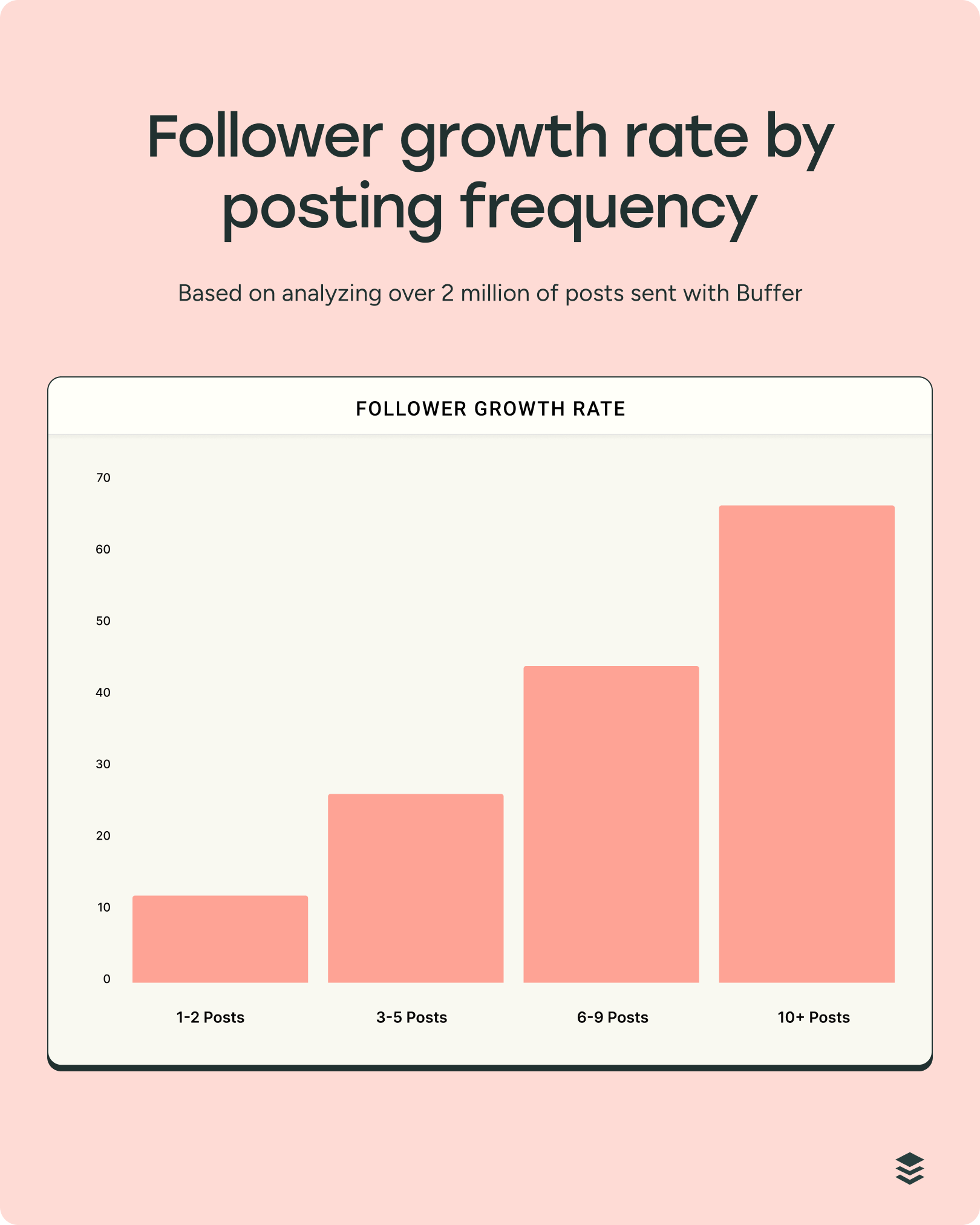
It controls for each account’s unique baseline and long-term behavior, then it measures whether follower growth goes up during weeks when that same account posts more often.
It confirms the same story:
1–2 posts per week: +0.12% follower growth rate
3–5 posts per week: +0.26% follower growth rate
6–9 posts per week: +0.44% follower growth rate
10+ posts per week: +0.66% follower growth rate
Note that we’re talking about an increase in follower growth rate, rather than % increase in total followers. Here’s a practical example:
I have 5K followers on Instagram. For simplicity's sake, let’s assume that when I don’t post at all, my account remains stagnant (my baseline growth rate is 0%).
Posting 1–2 times/week could mean about 6 more followers per week than not posting at all.
Posting 3–5 times/week could add about 13 more followers/week.
Posting 6–9 times/week could mean 22 more followers/week.
Posting 10+ times/week could mean 33 more followers/week.
The example above is also a really clear way to look at the diminishing returns of posting more than five times per week. I usually post once per week, so adding two more posts to my content calendar would probably net me around 13 more followers. Great! Two more posts aren’t a huge lift.
But to move myself up into the next category (and only gain 9 more followers, compared to the previous jump) I’d need to double the amount of extra posts I’m creating. More followers, yes, but I don’t have the bandwidth to create six Instagram posts every week — much less six good posts.
Armed with this data, I’ll happily bump my frequency up to 3 posts per week for a much more sustainable increase I can maintain long-term, without sacrificing the quality of my content.
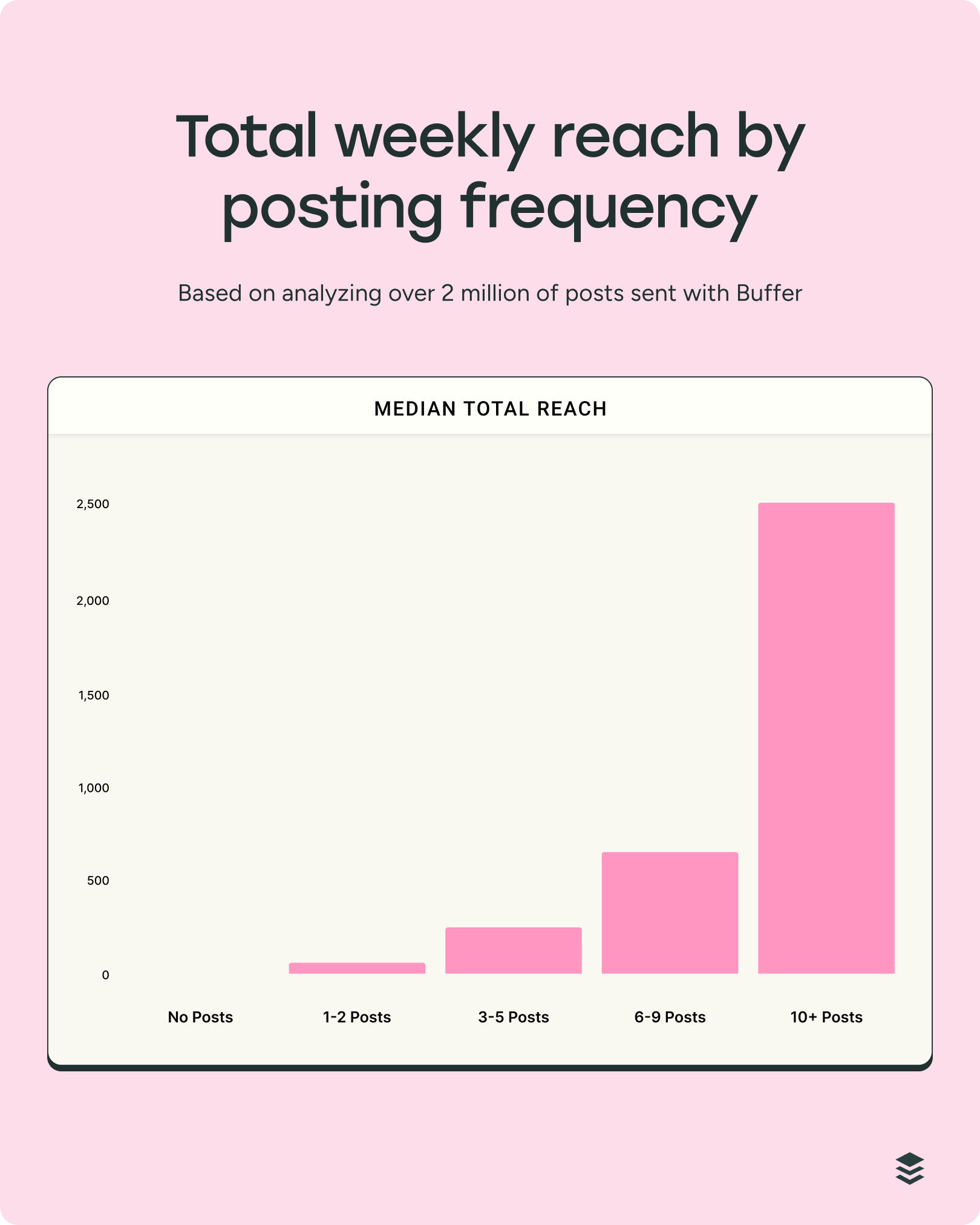
4. Posting more consistently increases weekly reach
Here’s another finding that wasn’t surprising, given that reach and follower growth tend to go hand in hand.
The more you post in any given week, the higher your reach for the week will be.
That’s pretty common sense… the more you post, the more opportunities you have for appearing in your followers’ home feeds, the reels feed, or even the explore page.
But here’s where things get interesting...
5. Posting more means more reach per post
He analyzed median reach per post, and found that accounts that post more tend to get more views on every piece of content.
“Each step up in posting frequency delivers substantial percentage gains in reach per post,” Julian says. “The largest jump occurs when moving from 1-2 to 3-5 posts.”
Compared to posting just 1–2 times per week:
Posting 3–5 posts/week = ~12% more reach per post
Posting 6–9 posts/week = ~18% more reach per post
Posting 10+ posts/week = ~24% more reach per post
This is a pretty clear signal that the Instagram algorithm rewards consistency.
“Even at higher frequencies, there are still meaningful 20-25% incremental gains for posting more frequently, however the returns are diminishing.”
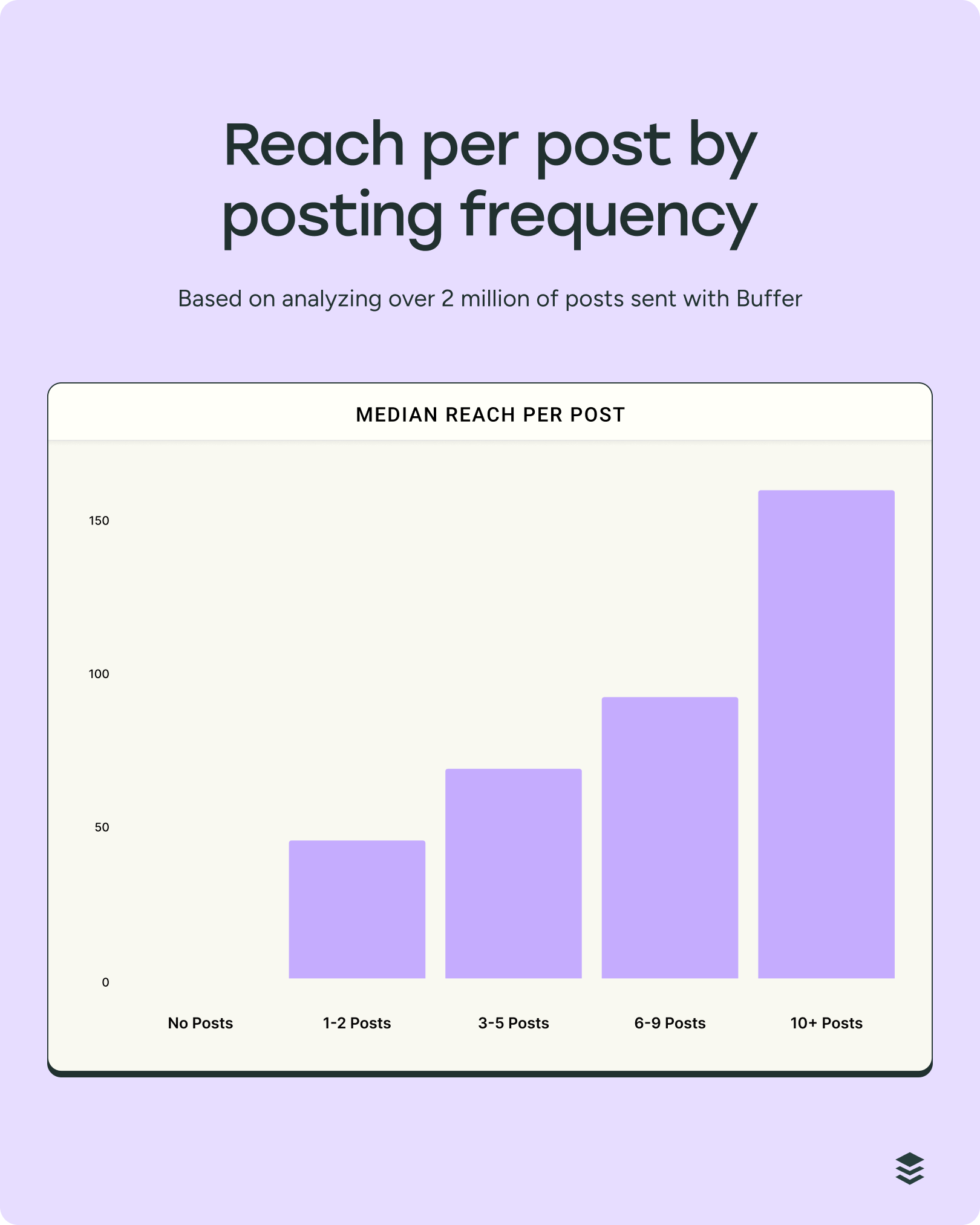
More diminishing returns here? Yep. As Julian pointed out, the biggest jump happens when you move from 1–2 to 3–5 posts per week. With each frequency jump, the reach gain shrinks every time.
So, what does all this mean for creators and brands looking to grow on Instagram?
The tempting conclusion is that posting more than 10 times per week on Instagram is the fastest way to increase reach and growth.
Technically speaking, it is. But creating more than 10 posts on Instagram per week might mean:
You have to drop the quality of your content in order to produce at that volume
Burnout — so you quit posting altogether after two or three weeks.
Both of these things might prove more detrimental to your overall follower growth than taking a more measured approach.
More does not always mean better
The best posting schedule is one you can stick to consistently.
“For me, the bottom line is that Instagram rewards frequent and consistent content creation,” Julian says. “However, there is a big caveat that the most important factor probably remains content quality. You’re probably not going to see big gains in followers and reach by pumping out low-quality posts.”
Posting frequency is one of the most powerful levers you can pull to grow on Instagram, and the numbers back that up. But remember: quality matters, and burnout is real.
Focus on consistent, sustainable effort over short bursts of high volume. Even small increases in how often you post can make a big difference.
At Watermark, we take the guessing out of the equation. We’re the full-time creators your business needs. Our base package starts at 7 posts per week, so you can maximize organic growth on Instagram without sacrificing quality (or risking burnout).